What opportunities do data centers represent today and in the future for Southern Italy?
This will be one of the hot topics of the next edition of SMART BUILDING EXPO. In this phase of accelerated digital transition, if managed intelligently, these facilities can become a powerful driver of economic growth and employment, capable of activating local production chains, attracting international investments, and revitalizing territories that have so far benefited from fewer opportunities for development.
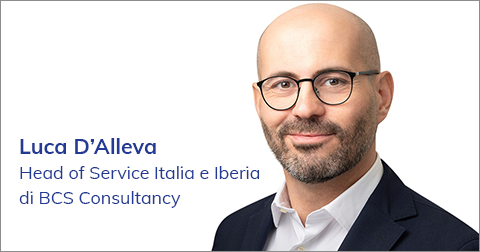
The topic will be discussed by Luca D’Alleva, Head of Service Italy & Iberia at BCS Consultancy, who will be among the speakers at the workshop “Data Centers: roadmap for sustainability – technological scenarios for a strategic infrastructure”, scheduled for November 19, from 4:00 to 6:00 p.m.
The recent debate on the opportunities that data centers can bring to Southern Italy deserves special attention during this phase of accelerated digital transformation. When managed intelligently, these facilities can become a powerful engine of economic and employment growth, capable of activating local value chains, attracting international investors, and revitalizing areas that have historically experienced fewer growth opportunities.
From my daily experience developing data center projects and analyzing their construction and operational costs, the potential of Southern Italy is evident. The availability of large land areas, more competitive real estate costs, and the ongoing enhancement of network infrastructure—such as submarine cables and next-generation backbones—make some areas of the South particularly attractive for this type of investment. However, this potential can only be fully realized through clear support policies and effective strategic planning.
It is therefore essential to streamline authorization processes, ensure a reliable and sustainable energy supply, and prepare the territory to host complex industrial investments typical of the data center sector.
Indeed, data centers are high-energy-consumption infrastructures, whose impact requires an integrated approach that takes into account energy, environmental, urban, and educational dimensions. A data center should not be viewed as an isolated technological enclave but rather as the core of an ecosystem capable of actively engaging local businesses, universities, suppliers, and institutions. Only through such integration can a genuine multiplier effect be generated, retaining and developing value within the territory.
Southern Italy now faces an extraordinary opportunity: to become a key player in the new European geography of data centers, offering a winning combination of territorial resources, incentive systems, and steadily evolving skills. This requires careful coordination between the public and private sectors, transforming potential into tangible achievements. From my perspective as a consultant, I observe daily that the difference between a successful infrastructure and one that struggles to emerge lies in the ability to plan strategically, control operating costs, and create a stable, sustainable long-term environment.
If the country is able to seize this development phase to the fullest, Southern Italy could evolve not only into a destination for investments but also into a true hub of expertise and innovation for the entire Southern European region.